Back
Back
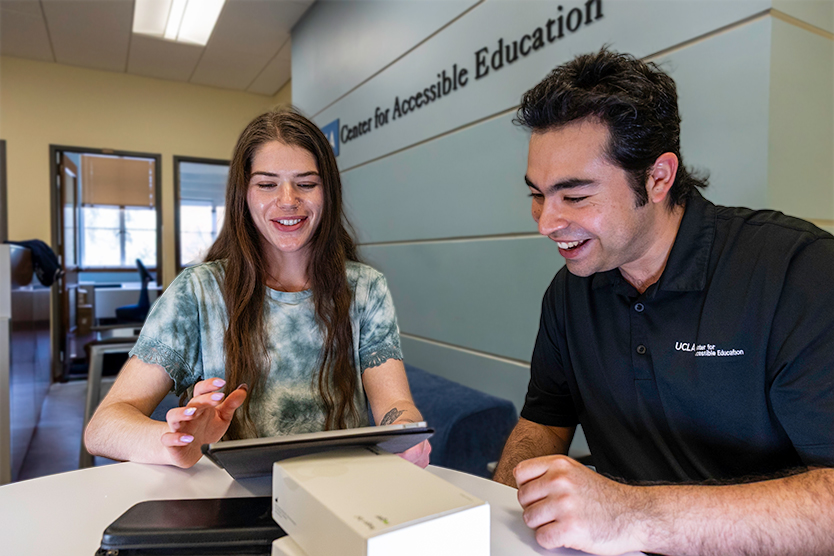
UCLA wants every student to flourish, on and off campus. For more than 5,000 disabled students per year, the Center for Accessible Education (CAE) is a valuable companion in their academic journey and preparation for rewarding careers.
For years, the Center has taken a holistic view toward making education accessible, offering wide-ranging support to students with disabilities. This can include help with housing and transportation as well as academic accommodations such as screen readers and note-taking services. However, the Center does not stop there.
“We want to understand how every student is unique, and how their conditions affect them on a daily basis, so they can find their pathway,” says Center director Spencer Scruggs. “Students come to UCLA with a wide range of disabilities and differences. Our goal is to make sure that they graduate with knowledge as well as the skill sets and confidence that will enable them to flourish after college.”
“Mini grants” launch major careers
A gift from the Nelson Foundation supports the Center as it helps students shift from campus to careers. Thanks to this donation, disabled students can apply for “mini grants” geared towards career development opportunities, laying the groundwork for continued success.
These grants let students afford networking events, custom professional clothing and travel to conferences. The financial support also makes it possible for students to take unpaid internships or gain other valuable forms of work experience.
Maximizing opportunities
Natalia C. is a fourth-year undergraduate student in cognitive science and art history. She conducts research at both the Rissman Memory Lab and the Language and Cognitive Development Lab at UCLA.
“As a student with mental health disabilities such as severe anxiety and depression, making the most of professional development has always been an uphill battle, especially when you add financial strain,” says Natalia. “The Center for Accessible Education has helped lift some of that burden and has made my UCLA experience more manageable and hopeful.”
With this support, Natalia is making important moves towards her goals. “The grant has made it possible for me to get to campus, cover essential expenses and commit myself fully to hands-on research,” she says. “These opportunities are preparing me for a future Ph.D. in behavioral health. I want to bring together research and real-world applications in mental health, particularly for underserved communities.”
Promoting autonomy
Another grant recipient is Alexa R., whose long-term aim is to attend medical school. She plans to specialize in neuropathy so she can treat patients with nerve conditions like hers. Alexa sometimes wears leg braces specially designed to give her optimal balance and comfort, which are critical as she volunteers as a caregiver for older adults. Funds from the grant enabled her to modify the braces to be more comfortable.
“I usually don’t need the leg braces at school,” she says, “but in a hospital setting, I need more balance so I can do things like help feed patients. The braces aid my walking overall without hurting the bottoms of my feet, so I don’t develop calluses or get injured while volunteering.”
Alexa’s grant also covers the cost of booking a car ride to and from the hospital on days when she is unable to take the bus.
This kind of targeted support makes the Center for Accessible Education a powerful partner for students like Natalia and Alexa. As Spencer Scruggs says, “Students with disabilities know what they need most as they navigate their coursework and plan rewarding lives. That’s the beauty of these mini grants — they allow students the flexibility they need.”
Give now to fund the work of the Center for Accessible Education.
To learn more about ways to support students, contact